Produce Taste regulation grid Book
SPECIFICATION
Product Name : Mini LED display unit (full color)
Specifications and models : XC0.9 H-V1-600*337.5 Common Cathode COB
Document Number :
Version number : 1.0
Drafted by: | Reviewer: | Approved: (Official Seal) |
Table of contents
2. Product Model Naming Instructions
7. Installation Hole Position Diagram
1. Scope of application
This technical manual applies only to indoor XC0.9 H cabinet full-screen products . The following are the parameters for standard products. Customization is available for special requirements.
2. Product Model Naming Guide
XC 0.9 H- V1 - 600X337.5x3 9.7 Common Cathode COB

3. Product Overview
Ø Each pixel on the front of the LED display screen is composed of R, G, B flip-chip integrated package, and each chip is fixed to the circuit board .
Ø The back of the LED display module contains driver ICs and components such as resistors and capacitors. When connected to the display control system, it can display information such as video, images and text.
Ø The LED display module is designed for front maintenance and requires the use of specialized suction cup tools for installation and debugging .
4. Product Appearance
Indoor XC0.9 module physical sample ( 150* 168.75 )
Front view | Back view | Remark |
|
| The driver chip used is an SSOP packaged constant current driver chip. |
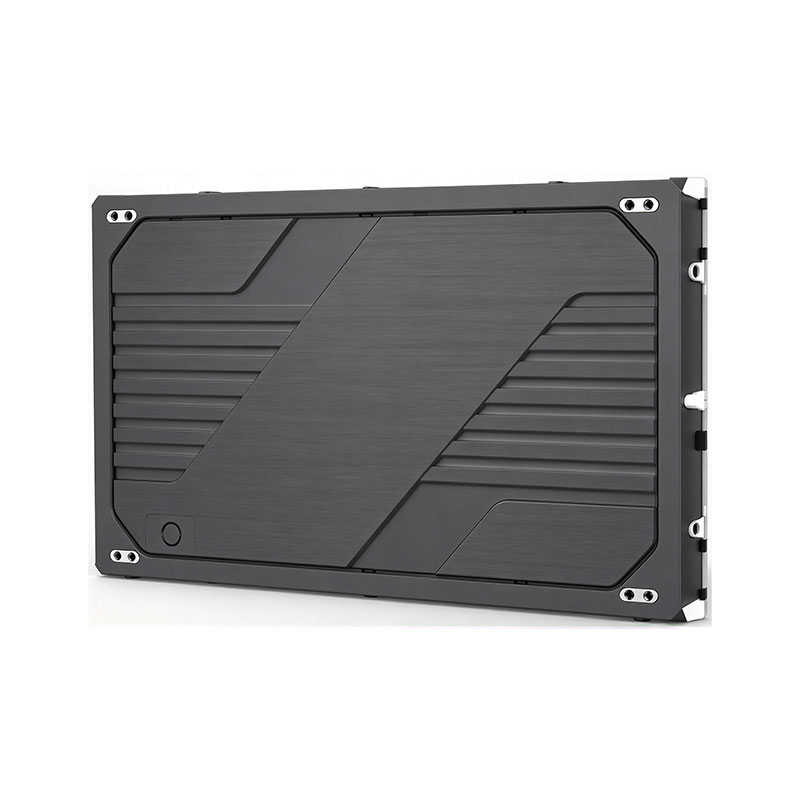
Indoor XC0.9 Actual box dimensions ( 600*337.5 )
Front view | Rear view |
|
|
5.
Technical Specifications
Parameter category/name | Indoor XC0.9 H | |
Product Parameters | Pixel composition | 1R1G1B |
Pixel pitch ( mm ) | 0.9 | |
Speaker resolution (length * width) | 640*360 | |
Pixel density ( Dots /㎡) | 1137777 | |
Lamp tube packaging | Inverted COB | |
Box dimensions ( mm ) (Length * Width * Thickness) | 600*337.5*39.7 [Including module] | |
Container area (㎡) | 0.2025 | |
Optical parameters | White balance brightness ( cd/m² ) | ≥600 |
Horizontal perspective ( °) | 160 | |
Vertical perspective ( °) | 160 | |
Brightness uniformity | 95% | |
Gray levels (B its ) | 13 | |
Electrical parameters | Power distribution power consumption ( W / m² ) | 474 |
Peak power consumption ( W / m² ) | 370 | |
Average power consumption ( W / m² ) | 123 | |
Power supply requirements ( V ) | AC:220 | |
Performance parameters | switching frequency ( Hz ) | 60 |
driving method | Constant current drive | |
Driver IC | Common Cathode Constant Current | |
Refresh rate ( Hz ) | 3840 | |
Use parameters | Typical lifespan ( hrs ) | ≥5000 |
Operating temperature range (°C) | - 1 0~ 4 0 | |
Storage temperature range (°C) | -40~60 | |
Operating humidity range ( % RH ) | 10-90 | |
Storage humidity range ( % RH ) | 10-60 | |
Optional Equipment List | Main power cord | 3*2.5mm² power cord, 1000cm long, 50mm stripped at both ends. |
Main network cable | Cat5e network cable, 1500cm, gold-plated, 6U, 568B unshielded. | |
Vacuum suction cup | 90mm long x 90mm wide | |
6. Installation hole location diagram
6.1. Recommended mounting hole layout for a 600*337.5mm enclosure :
Remark: All dimensions are in mm.
7. Precautions
matter | describe |
Temperature requirements | Storage temperature range: -40℃ to +60℃. Cooling is required if the temperature exceeds 60℃ . Operating temperature range: -10℃ to +40℃. For other temperature ranges, a temperature control device needs to be installed. Temperature control equipment needs to be installed when the surface temperature of the display screen lamp is ≥60℃. |
Humidity requirements | Storage humidity range: 10%RH~60%RH; dehumidification is required if the humidity exceeds 60%RH. Operating humidity range: 10%RH~90%RH. If the humidity exceeds the standard, the environment must be dehumidified before normal use. |
Expired storage deal with | Products stored for more than one month must undergo a 6-hour aging process before normal use. The aging process is as follows: full brightness setting 10%/1hrs, full brightness setting 30%/1hrs, full brightness setting 60%/2hrs, full brightness setting 80%/1hrs, and full brightness setting 100%/1hrs (brightness gradually increases during aging). |
Dust prevention requirements | Indoor products have a low level of protection and should not be exposed to dusty environments, such as studio renovations or alterations, requiring special protection for the display screen. |
Corrosion resistance gas | Corrosive gases in environments containing salt or acid can cause corrosion, crystallization, and leakage of electronic components. |
Electromagnetic radiation protection | The display screen should not be placed in an environment where electromagnetic radiation or radio frequency radiation exceeds the electric field strength of 5V/m. |
shockproof | The display screen should be installed on a sturdy and reliable mounting structure free from strong vibrations. |
away from water sources | Indoor products have low protection levels, and water conducts electricity, which can cause short circuits and damage circuit components. Therefore, they should be kept away from water sources. |
Electrostatic protection | Do not touch the product with bare hands to prevent static electricity from damaging the internal components. Wear rubber gloves when touching the product. |
Preventing lightning strikes | Effective protective measures should be taken for display screens during thunderstorms. |
Personal injury | The installation angle and height of the display screen must be appropriate, and sharp edges and corners must be covered to prevent injury to the human body from the hard casing. |
Safety requirements | The stability of the power supply system must be ensured, maintaining normal levels of frequency, voltage, and current harmonics. During installation, the metal casing of the LED display screen should be grounded together with the metal frame on which the LED display screen is installed, and the overall grounding resistance of the display screen system should not exceed 1Ω. The ground leakage current should not exceed 5% of the input current. The dielectric strength should meet the requirements of SJ/T 11141—2017 General Specification for Light Emitting Diode (LED) Display Screens, 5.7.5. |
other | The surface of the display screen must not be wiped with alcohol or other organic solvents; it can only be wiped with pure water and a fine, lint-free cloth. Do not touch the surface of the display screen directly with your hands; wear rubber gloves when disassembling or assembling. |
8. Installation Guide
8.1. Display screen acceptance requirements and methods :
Screen brightness: Set the screen to full brightness and adjust the brightness efficiency in the testing software on the computer to 80% . Measure the screen brightness using a light gun within 10 minutes . When measuring brightness, the light gun must be aimed directly at the screen, ideally level with it. Ensure that the black area in the observation window covers at least 16 pixels , and adjust the focus for measurement.
Viewing angle: When measuring, the person is about 3 meters away from the screen and views it from a 90 ° angle . The screen should be free of obvious black spots and dark patches.
8.2. Grounding: The switching power supply casing, enclosure, and panel structure are correctly grounded, and the grounding point is correctly marked with the grounding mark . An inspection should be carried out every six months.
8.3. Lightning protection measures: Buildings are required to have lightning rods or lightning protection strips with effective grounding. Distribution boxes are required to have surge protectors. Lightning protection facilities should be inspected every six months.