A distributor in Riyadh or an installer in Dubai rarely loses a project on the purchase price alone. The loss comes eighteen months after handover, when a screen that looked flawless in the showroom develops dead pixels, fading red LEDs and a grey haze behind the mask that no amount of cleaning removes. Choosing LED display modules for outdoor advertising in the Middle East is a different discipline from specifying them for a European shopping mall or a North American stadium. Ambient temperatures above 45 degrees Celsius, direct solar load, fine desert dust, coastal salt fog and unstable distribution transformers all attack the module at the same time. This guide walks through the engineering decisions that actually determine whether an outdoor LED screen survives its warranty period in this climate.
Why the Middle East Environment Rewrites the Specification
Most catalogue data for outdoor LED display modules is generated under laboratory conditions at 25 degrees Celsius with a clean power supply. In the Gulf and Levant that baseline is optimistic. A module rated for 50 degrees Celsius ambient is not rated for a black cabinet face in direct afternoon sun, where surface temperatures can exceed the ambient reading by a wide margin. Heat accelerates the degradation of the encapsulant around each LED die, shifts color coordinates and shortens driver IC life.
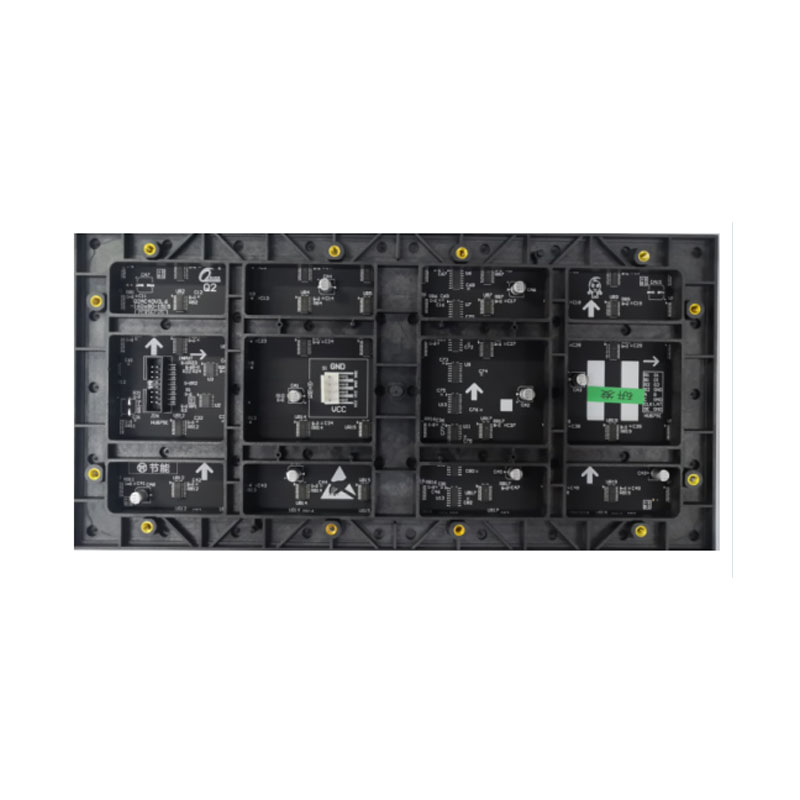
Dust is the second pressure. Particles below 10 microns pass through gaps that stop water, settling on driver boards and creating leakage paths between scan lines. On the coast, from Jeddah to Dubai to Doha and Muscat, airborne chloride adds corrosion to the same equation. The practical consequence is simple: a module that is adequate for inland Europe is not automatically adequate here, and the specification must be written around thermal margin, sealing and corrosion resistance rather than around price per square meter.
Pixel Pitch: Match It to the Advertiser, Not to the Catalogue
Pixel pitch sets both resolution and cost, and it is the specification buyers most often over- or under-order. The working rule of thumb for outdoor advertising is that one millimeter of pitch corresponds to roughly one meter of comfortable minimum viewing distance. A 10 mm module therefore suits a roadside billboard read from ten meters and beyond, while a 4 mm module belongs on a facade where pedestrians and slow traffic pass within four meters.
Beyond the rule, consider content. A roadside unit showing a single line of large text and a logo at eight-second intervals gains nothing from a 3 mm module — the advertiser does not pay for resolution nobody can resolve. Conversely, a retail LED screen in a mall entrance or a city-center totem that runs full-motion brand video will be judged pixel by pixel at close range, and there a finer pitch is the difference between a premium impression and a visibly blocky one. Ask what content will run, at what speed and from what distance, before you fix the pitch. That answer usually settles the budget question on its own.
Brightness, Refresh Rate and Grayscale Under Full Sunlight
Outdoor LED display modules for advertising in this region are normally specified between 5,000 and 10,000 nits. In practice, a facade facing west in Dubai or Kuwait needs the upper half of that range to stay legible at 5 p.m., while a shaded or north-facing surface can be specified lower and will run cooler and last longer. Higher peak brightness is not automatically better: every extra nit is extra current, extra heat and faster lumen depreciation. The intelligent specification is the lowest brightness that remains readable in the worst hour of the worst day, with automatic dimming via ambient light sensor to protect the LEDs the rest of the time.
Refresh rate matters more than many buyers expect, because outdoor advertising is photographed constantly. For screens that will appear on camera, mobile phones or broadcast, a refresh rate of at least 1,920 Hz is the floor and 3,840 Hz and above is the safe choice; below that, viewers see scan lines and banding in every photo. Pair high refresh with genuine 14-bit or 16-bit grayscale processing so that low-brightness content — a dark background with white text, common in advertising — renders smoothly instead of stepping through visible bands.
Sealing, Dust and Thermal Design
Enclosure rating is defined by IEC 60529, and for outdoor advertising modules in dusty environments the realistic target is IP65 front and rear, not the IP65 front and IP54 rear often quoted for milder markets. The rear of a module is where dust does its damage, and rear-side ingress protection is the specification most frequently downgraded to shave cost.
Look beyond the rating label. Conformal coating on the driver PCB, sealed cable glands, gasketed module joints, and a mask design that sheds rather than traps dust all matter. For coastal installations, ask for salt fog resistance tested to a recognized standard such as ASTM B117, and confirm the cabinet frame treatment — powder-coated steel and anodized aluminum behave very differently after three years of sea air.
Heat is managed through the whole assembly, not the module alone. Aluminum cabinets conduct heat away from the module far better than thin steel, and passive designs with generous fin area avoid the fan failures that plague forced-air units in dust. If active cooling is unavoidable, specify filtered, serviceable fans and expect a maintenance schedule. Power consumption typically runs in the range of 200 to 400 watts per square meter under average video content, but peak-white figures are several times higher, and the power supply and cabling must be sized for peak, not average.
Power Standards, Driver ICs and Scan Mode
Mains conditions vary across the region: Saudi Arabia operates at 220 volts and 60 Hz, the UAE, Qatar and Kuwait at 230 to 240 volts and 50 Hz, Jordan at 230 volts and Lebanon and Egypt at 220 volts. Buildings frequently see voltage sag and spikes, especially where transformers are shared. Specify power supplies with a wide input range, surge protection at the cabinet and, on larger installations, consider active voltage regulation. Cheap drivers that tolerate narrow input windows are a common cause of whole-cabinet blackouts that get blamed on the module.
Internally, the driver IC and scan mode govern grayscale performance, ghosting and the dreaded first-line dimming seen at the top of each scan group. Constant-current driver ICs with high refresh support and 16-scan or 8-scan architecture generally deliver better low-gray behavior and wider gray scale than aggressive high-scan designs chosen purely for cost. Ask for the driver IC part family in writing, and test a sample at low brightness on camera before you commit a container order.
Calibration and Consistency Across Modules
A screen is judged as one surface, not as hundreds of individual modules. Module-to-module variation in brightness and color is what makes a wall look patched. Reputable manufacturers calibrate at the factory and supply modules within a tight tolerance — commonly within about 3 percent on brightness and a small color coordinate window — and they provide measured reports rather than a claim.
On site, calibration should be repeated after installation. A spectroradiometer or calibrated colorimeter pass that writes correction coefficients to each module compensates for environmental differences and for the natural variance between production batches. Insist on this step at commissioning and again within the first year, because it is the single cheapest way to protect the visual quality the advertiser is paying for.
A Practical Selection Checklist
Confirm the actual viewing distance and content type before locking pixel pitch.
Require IP65 on both faces, with documented test method and salt fog data for coastal sites.
Specify brightness with an automatic dimming range, and demand the thermal derating curve, not just the peak figure.
Ask for refresh rate at 1,920 Hz minimum, 3,840 Hz if the screen will be filmed.
Get the driver IC family, scan mode and grayscale depth in writing.
Check cabinet material, flatness tolerance and the heat path from module to ambient air.
Verify power supply input range against the local voltage and frequency, plus surge protection detail.
Request factory calibration reports and budget for on-site calibration at commissioning.
Order a sample module, and test it in your own climate before scaling to a full order.
Agree spare parts coverage of a few percent and a written warranty that names the LED, driver IC and power supply separately.
For distributors, installers and rental operators across the Gulf, Levant and North Africa, HITULED builds outdoor LED display modules with regional power configurations, IP65 sealing on both faces, and calibration reports supplied with every batch. If you are specifying a new facade, billboard or totem, send us your viewing distance, content type and site conditions, and we will recommend a configuration and provide a sample for your own evaluation.