A technical guide for retail property owners, LED display distributors, system integrators and commercial display procurement teams
HITU Display | Commercial LED Display Solutions

Executive Summary
Large-format LED displays have become an important part of the visual communication infrastructure of shopping centres. Installed on building facades, above entrances and in high-traffic public areas, they provide space for retail campaigns, seasonal promotions, brand advertising and public information.
However, a successful shopping mall LED installation is not simply a matter of selecting a large screen with high brightness. The display must work as part of a larger system involving the building structure, ambient lighting, electrical supply, content management, viewing distances, environmental protection and maintenance access.
For overseas buyers, the procurement decision should therefore be based on the complete application rather than a single specification or the initial price per square metre.
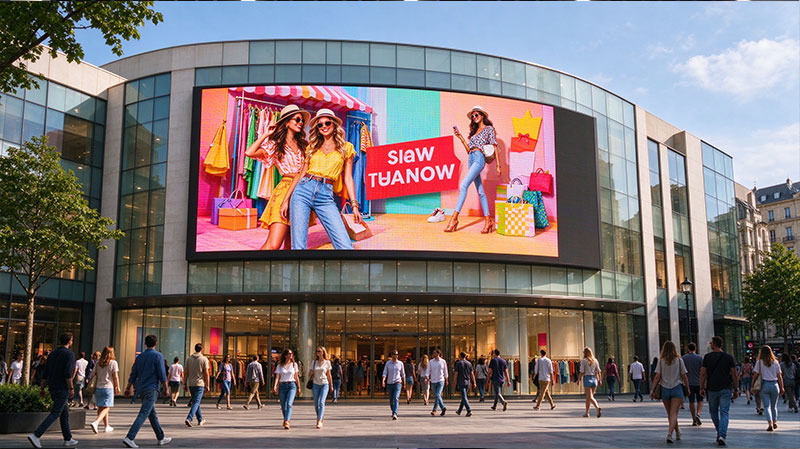
This white paper examines the engineering and purchasing considerations for shopping mall LED displays, with particular attention to large outdoor facade installations such as the one shown in the reference image.
Key procurement principle
Specify the display around its installation environment, viewing conditions, required content and maintenance plan. Then evaluate the LED modules, cabinets and system components against those requirements.
1. Understanding the Shopping Mall LED Display Application
A shopping mall is a mixed-use commercial environment. Its display requirements vary significantly depending on whether the screen is installed outdoors, behind glazing, inside an atrium or along a retail corridor.
The reference image illustrates a large LED screen integrated into the facade of a contemporary shopping centre. Its position above the main entrance makes it visible to pedestrians approaching the building and potentially to people viewing the facade from across the surrounding public space.

1.1 Typical installation zones
Location | Primary function | Main engineering considerations |
|---|---|---|
Exterior building facade | Advertising and brand campaigns | Sunlight, weather, wind load, structural support |
Main entrance | Promotions and visitor communication | Close viewing, pedestrian circulation, architectural integration |
Central atrium | Brand experiences and events | Viewing from multiple floors, indoor lighting, acoustics |
Retail corridors | Tenant advertising and promotions | Viewing distance, reflections, screen dimensions |
Food court | Menus, campaigns and information | Text readability, content scheduling, viewing angles |
Shop windows | Retail promotions | Daylight, heat, reflections, visibility through glazing |
A facade screen and an indoor feature wall should not automatically share the same hardware specification. Outdoor installations face environmental exposure, while indoor screens generally place greater emphasis on close-range image quality, fine detail and integration into the interior.
1.2 The commercial role of a facade screen
For shopping centre operators, an exterior LED display may serve several purposes:
Promote seasonal sales, new store openings and shopping events.
Provide advertising inventory for tenants and external brands.
Strengthen the visual identity of the property.
Support coordinated campaigns across the building and its digital channels.
Display selected public information or event announcements.
For an integrator or distributor, these functions translate into different technical and commercial requirements. A screen designed primarily for large campaign imagery may not need the same pixel density as one expected to display detailed text at close range.
The project brief should define the primary content types before the display configuration is finalised.
2. Pixel Pitch and Resolution: Matching Image Quality to Viewing Distance
Pixel pitch is the distance, measured in millimetres, between the centres of adjacent LED pixels. It directly determines the physical pixel density of the display.
A smaller pixel pitch provides more pixels within a given screen area, allowing finer image detail. It also generally increases the cost of the LED display because more densely arranged components are required.
A larger pitch may be appropriate when the display is viewed from farther away and its content is designed for large-scale visibility.
2.1 Selecting pixel pitch for a mall facade
The correct pixel pitch depends on the nearest important viewing position, the intended screen dimensions and the actual content.
For example, a screen mounted high on a shopping centre facade and primarily viewed from across a plaza has different requirements from an entrance display viewed by pedestrians standing a few metres away.
The following ranges are starting points for project discussions, not universal specifications.
Application | Illustrative pitch range | Main consideration |
|---|---|---|
Large facade advertising | P6–P10 | Viewing distance and overall screen scale |
Pedestrian-facing exterior display | P3–P6 | Close-range image detail |
Large indoor atrium wall | P2.5–P4 | Multiple viewing distances |
Indoor retail feature wall | P1.5–P3 | Detailed imagery and close viewing |
These ranges should be validated against the actual site. The same nominal pitch can produce different practical results depending on screen size, viewing angle, content layout and the distance at which people normally observe the display.
2.2 Resolution must be evaluated with the physical screen dimensions
A common procurement mistake is to compare two displays based only on pixel pitch without checking their total resolution.
For a display with a fixed physical width and height, a smaller pitch produces a higher native pixel count. But that additional resolution is useful only if it improves the intended viewing experience.
For example, a large outdoor screen displaying campaign artwork, logos and short promotional messages may not need the same detail as a close-view retail screen showing product information.
Before approving a quotation, request:
Total display width and height.
Pixel pitch and native resolution.
Cabinet arrangement and total cabinet count.
A content mock-up using the proposed resolution.
Confirmation that the content processor supports the required output resolution.
A scaled visual simulation can help the buyer assess whether the proposed configuration is suitable for the real viewing conditions.
3. Brightness, Daylight and Night-time Operation
Brightness is one of the most important considerations for an outdoor shopping mall display.
An exterior screen may receive direct sunlight, reflected daylight from surrounding glass buildings and changing ambient light throughout the day. A display that looks clear in a shaded showroom may appear washed out under real outdoor conditions.
However, maximum brightness should not be treated as the sole measure of image quality.
3.1 Outdoor brightness requirements
For full-sunlight outdoor applications, high-brightness LED systems are commonly specified in the several-thousand-nit range. Depending on orientation, local daylight conditions, glazing reflections and screen position, the project may require a different configuration.
As a preliminary specification discussion, buyers can compare outdoor solutions around 5,000–8,000 nits, then validate the required operating brightness through a site assessment and a review of the supplier's product data.
The final selection should account for:
Direct sunlight exposure.
Facade orientation and shading.
Viewing distance and screen size.
Local ambient-light conditions.
Night-time brightness limits and nearby residences.
Power consumption and thermal performance.
Outdoor buyer guidance also emphasises that the screen should be selected according to the installation environment, rather than a headline brightness figure alone.
3.2 Automatic brightness adjustment
A brightness-control system can adjust the display output according to ambient light or a configured operating schedule.
For a shopping centre, this is relevant because the screen may operate during bright daylight, evening shopping hours and after dark.
A suitable control strategy should help maintain readability without unnecessarily operating the display at its maximum brightness throughout the day.
During procurement, clarify:
Whether an ambient-light sensor is included.
Whether brightness can be scheduled or adjusted remotely.
Whether the control system supports configurable brightness limits.
How the screen behaves if the sensor or control connection fails.
Whether the display can be integrated into the operator's existing management workflow.
The appropriate brightness policy should also be checked against local planning conditions, signage rules and any applicable restrictions on illuminated advertising.
4. Outdoor Protection and Environmental Design
An exterior LED display is part of the building envelope's operating environment, but it is not automatically a replacement for any existing facade weatherproofing system.
The design must account for rain, dust, moisture, temperature changes, wind exposure and the specific construction details surrounding the display.
4.1 Understanding IP protection
Ingress Protection (IP) ratings classify protection against access to hazardous parts, solid objects and water under defined test conditions.
For a permanently installed outdoor display, buyers commonly review products with IP65-level protection on the exposed face. The required protection for the rear and other components depends on the cabinet design and the installation environment.
A quoted IP rating should always be tied to the actual configuration being supplied.
Questions to ask the manufacturer include:
Which parts of the complete display have been tested?
Is the stated rating applicable to the module, cabinet or assembled screen?
Are connectors and cable entry points included in the protection design?
What installation orientation and sealing conditions are required?
Is there a test report or other supporting documentation?
An IP rating should not be interpreted as proof of resistance to every weather condition, installation error or long-term environmental exposure.
4.2 Corrosion, humidity and temperature
The material and finish of the cabinet should be selected with reference to the site conditions.
A coastal shopping centre, for example, may face a different corrosion environment from a shopping centre in a dry inland location. Similarly, a facade exposed to intense sunlight may experience different thermal conditions from a shaded installation.
The engineering review should cover:
Cabinet and fastener materials.
Surface coatings and corrosion protection.
Water drainage and sealing.
Ventilation and heat dissipation.
The specified operating and storage temperature ranges.
Access to components that may require replacement.
For overseas projects, it is important to distinguish between the manufacturer's stated operating temperature range and the actual temperature conditions expected inside the installed cabinet.
5. Cabinet Design, Structural Integration and Installation
The LED display shown in the reference image is integrated into a large building facade. Installations of this type require coordination between the display supplier, structural engineer, facade contractor, electrical contractor and installation team.
The screen itself is only one part of the installation.
5.1 Structural considerations
The supporting structure must be designed for the actual display configuration and the building's conditions.
Relevant project information includes:
Overall screen dimensions and total installed weight.
Cabinet dimensions and mounting locations.
Wind loads and local structural design requirements.
Supporting wall or steel-frame conditions.
Access for lifting, installation and future service.
Cable routes and electrical distribution.
Any required separation from the existing facade system.
A manufacturer's cabinet weight is not the same as the total installed system weight. The supporting structure may also need to accommodate frames, brackets, access platforms, cable management and other installation components.
Structural calculations and approval should be completed by qualified professionals familiar with the project location and applicable codes.
5.2 Maintenance access should be planned before installation
Maintenance access is particularly important for a large screen mounted above a busy entrance.
If the display is designed for rear maintenance, the project must provide appropriate rear access and working space. If it is designed for front maintenance, the module and cabinet arrangement must support the intended front-service procedure.
Neither arrangement is universally suitable. The correct approach depends on the available space, cabinet design, service frequency and replacement method.
For mall operators, the service plan should address:
How faulty modules are identified.
How replacement parts are accessed.
Whether the screen can remain partially operational during repairs.
Whether maintenance can be performed outside public opening hours.
Whether lifting equipment or specialist access systems are required.
How replacement modules are matched to the existing display.
A clear maintenance strategy can reduce operational disruption and help avoid expensive modifications after installation.
6. Power Supply, Heat Dissipation and Operating Efficiency
A large LED display is a substantial electrical load. Power planning should therefore be based on the proposed screen area, product configuration, content and operating schedule.
Two different power figures are especially important in procurement:
Maximum power consumption represents a specified high-load operating condition.
Typical or average power consumption represents a different operating condition and should be understood in relation to the manufacturer's test method and stated assumptions.
These figures should not be used interchangeably.
6.1 Power planning
The electrical design should be coordinated with the building's available supply and the installation's distribution arrangements.
Before placing an order, request the manufacturer's declared maximum and typical power figures, the required input supply, circuit recommendations and relevant electrical documentation.
The project team should also establish whether the installation requires dedicated circuits, additional distribution equipment or specific isolation arrangements.
For operators comparing multiple quotations, power consumption should be assessed using consistent assumptions about screen size, brightness and operating hours.
6.2 Thermal management
Heat is generated by LED components, driver electronics and power equipment during operation.
The thermal design should allow the display to operate within the component and product limits stated by the manufacturer.
Depending on the cabinet and installation design, thermal management may use passive heat dissipation, ventilation or active cooling.
The choice must take account of:
Solar heating of the display and supporting structure.
Airflow around the cabinet.
Internal component temperatures.
Dust and moisture protection.
Ambient temperature.
Maintenance access to cooling components, where fitted.
For an enclosed or partially enclosed facade installation, the project team should review the actual airflow conditions rather than assuming that the cabinet will have the same thermal behaviour as an exposed test sample.
7. LED Modules, Cabinet Consistency and Display Quality
A large shopping mall display is assembled from many individual LED modules and cabinets. Consistency across these components is essential for a uniform visual result.
Buyers should evaluate the display as a complete assembled system, not just as a collection of individual modules.
7.1 Colour and brightness consistency
Visible differences between neighbouring cabinets or modules can affect the appearance of large uniform backgrounds, brand colours and full-screen video.
Procurement specifications should identify the supplier's process for colour calibration, brightness adjustment and module replacement.
Useful questions include:
Is the complete screen calibrated after assembly?
How is brightness and colour consistency maintained between modules?
Are calibration data and procedures available for maintenance?
How are replacement modules matched to the original screen?
What inspection criteria are used before shipment?
For projects that rely on corporate brand colours, it is particularly useful to agree on the evaluation process and reference content before production.
7.2 Refresh rate and camera applications
The refresh rate and driving configuration should be selected with reference to the content and any planned camera use.
A display intended mainly for normal pedestrian viewing may have different requirements from a screen that will regularly appear in promotional video production, livestreams or recorded events.
Buyers should request the relevant technical specifications and, if camera recording is part of the use case, arrange a practical camera test using the intended equipment and shooting settings.
A single refresh-rate number should not be treated as a complete guarantee of camera performance.
8. Control Systems and Content Management
A shopping mall facade display may need to support a regular advertising schedule, seasonal campaigns and last-minute content changes.
The control system should be evaluated as part of the full installation rather than treated as an accessory to the LED hardware.
8.1 Content playback requirements
The project brief should define:
Supported video and image formats.
Native screen resolution and content scaling.
Playback scheduling and campaign rotation.
Remote content upload and management.
User permissions and access control.
Network connectivity and operational monitoring.
Recovery procedures after a power or network interruption.
For a property operator managing several displays, the ability to organise content across multiple locations may be particularly relevant.
For a distributor or integrator, it is also important to identify which parts of the control system are supplied by the LED manufacturer and which are supplied by a third-party provider.
8.2 Content must be designed for the display
A large facade screen is usually viewed from a range of distances and under changing lighting conditions.
Content designed for a desktop monitor may not be suitable without adjustment.
Effective facade content typically uses clear visual hierarchy, readable text, strong imagery and a layout that works at the actual screen dimensions.
The creative team should receive the confirmed pixel resolution, screen orientation, aspect ratio, playback specifications and any limitations of the content management system before producing final assets.
9. Procurement: What Overseas Buyers Should Evaluate
For overseas procurement teams, a useful quotation should make it possible to compare technically equivalent solutions.
A lower unit price does not necessarily represent a lower installed cost if the quotation excludes important system components, supporting structures, installation accessories or maintenance provisions.
9.1 Factory evaluation
A professional procurement review should examine how the manufacturer controls the consistency and traceability of the supplied product.
Where relevant, request evidence of:
Incoming component inspection.
Module assembly and soldering controls.
Cabinet assembly and wiring inspection.
Display calibration and visual inspection.
Functional testing before packing.
Product identification and batch traceability.
Handling of non-conforming products.
Technical support and replacement-part procedures.
The precise inspection process varies by product type and manufacturer. Buyers should ask for the inspection plan that applies to the actual product being quoted, rather than relying on generic claims about factory quality.
9.2 Documentation and compliance
For a project in Europe or North America, confirm which standards and regulatory requirements apply to the final product and its intended installation.
The supplier should identify the relevant declarations, test reports and technical documents for the actual configuration.
Depending on the product and market, the project team may need to review electrical safety, electromagnetic compatibility, material restrictions, installation requirements and local building regulations.
A generic certificate or a document for a different product model should not be accepted as evidence that the proposed system meets the project's requirements.
10. Total Cost of Ownership and Long-Term Operation
The initial purchase price is only one part of the commercial cost of a shopping mall LED display.
A more complete assessment considers the costs and operational implications over the expected service period.
Cost area | What procurement should assess |
|---|---|
Display hardware | Modules, cabinets, power supplies and control components |
Installation | Supporting structure, lifting, wiring and commissioning |
Energy | Actual operating brightness, schedule and power consumption |
Maintenance | Labour, access equipment, inspection and repairs |
Spare parts | Availability, compatibility and storage requirements |
Content management | Software, network and ongoing content operations |
Downtime | Service response, replacement procedures and business disruption |
An appropriate comparison should use the same screen area, brightness assumptions, operating schedule and system scope for each supplier.
It should also distinguish between the manufacturer's warranty, the expected operating life of individual components and any service agreement offered by the integrator. These are different commitments and should be documented separately.
11. Project Workflow: From Site Survey to Commissioning
A well-defined project workflow helps coordinate the manufacturer, integrator and property operator.
Application and site assessment
Confirm the intended use, viewing zones, ambient lighting, facade orientation, mounting conditions, electrical supply and access limitations.
Technical specification
Establish screen dimensions, pixel pitch, resolution, brightness, protection requirements, cabinet configuration and control-system scope.
Engineering coordination
Review the supporting structure, electrical distribution, ventilation, cable routing, maintenance access and local approval requirements.
Manufacturing and inspection
Confirm the approved product configuration, component specifications, production inspection criteria and documentation required for shipment.
Installation and commissioning
Install the supporting structure and display, complete electrical and signal connections, configure the control system and verify operation.
Handover and maintenance
Provide operating instructions, configuration records, maintenance procedures, spare-parts information and relevant warranty documentation.
For a large facade project, the engineering review should begin before the display dimensions and mounting arrangement are treated as final. Changes to structural support, access arrangements or cable routing can affect both cost and schedule.
12. Questions to Ask an LED Display Manufacturer
Before selecting a supplier, overseas buyers can use the following questions to clarify whether a proposed product is suitable for their specific project.
Product configuration
Is the proposed LED display designed for permanent outdoor installation?
Which pixel pitches and cabinet formats are available for the required screen dimensions?
What are the native resolution and actual brightness specifications?
Which front and rear protection ratings apply to the complete configuration?
Engineering and installation
Can the supplier provide cabinet drawings, product weight and mounting information?
What information is required from the structural engineer?
Does the proposed configuration support front or rear maintenance?
What are the ventilation and thermal requirements?
Quality and support
What inspection and calibration procedures apply before shipment?
What technical documentation is available for the selected model?
Which components are considered replaceable?
How are spare parts identified and matched to an installed display?
What are the warranty exclusions and support arrangements?
Commercial and project coordination
What is included in the quotation and what must be supplied locally?
Who is responsible for installation and commissioning?
Which party supplies the control system and content management software?
What are the agreed delivery milestones and acceptance criteria?
These questions help turn a general request for quotation into a more precise engineering and commercial discussion.
13. Conclusion
A shopping mall LED display is a long-term commercial installation that must balance visibility, image quality, environmental protection, structural integration, operating efficiency and maintainability.
For a large exterior facade, the first decisions should be based on the real viewing environment, the intended advertising content and the building's engineering constraints. Pixel pitch, brightness and protection ratings should then be selected as part of a complete system specification.
For overseas buyers, the procurement process should also include a clear review of manufacturing quality, product documentation, installation responsibilities, spare-parts planning and after-sales support.
A technically suitable LED display is not simply one with impressive individual specifications. It is one whose complete configuration can meet the project's actual operating requirements and can be installed, operated and maintained as intended.
About HITU Display
HITU Display focuses on LED display modules and related display products for commercial applications. For shopping mall projects, overseas buyers and system integrators should define the required screen configuration, installation environment and project scope before requesting a technical proposal.
For an RFQ, prepare:
Target screen width and height.
Indoor or outdoor installation location.
Approximate viewing distance.
Required pixel pitch or image-detail expectations.
Site photographs or facade drawings.
Destination country and expected project schedule.
These details provide a practical starting point for product selection and technical coordination.
Technical reference note: The pixel-pitch and environmental ranges in this document are preliminary selection guidance, not guaranteed specifications for a particular product. Final values should be confirmed against the selected manufacturer's datasheet, installation drawings and project-specific engineering review.